



Designed according to project-specific requirements and engineered for CO₂-typical operating conditions, our wellheads and ball valves ensure high operational safety and plant availability. CO₂ differs fundamentally from natural gas or hydrogen: density, phase behavior, and strong temperature drops caused by Joule–Thomson effects, phase changes up to ice and dry ice formation, as well as high stored energy during pressure release, place special demands on the design.
The use of fully metal-seated ball valves prevents CO₂ diffusion into elastomeric sealing materials, reduces the risk of Explosive/Rapid Gas Decompression (AED/ED/RGD), and ensures high reliability, long service life, and low maintenance effort.
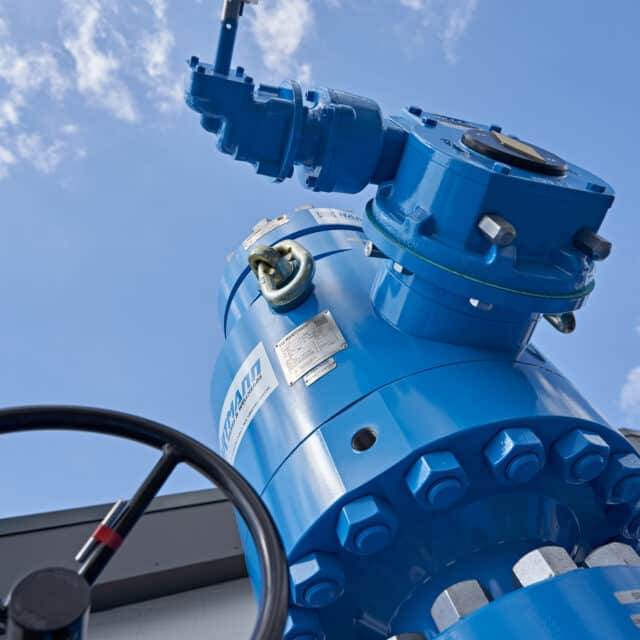
CO₂ places special demands on sealing technology, as elastomers are often the limiting factor. Our ball valves are therefore available in two design variants:
The ball valve is specifically designed for CO₂-typical operating conditions. The rotating ball within its own volume prevents blockages caused by ice or dry ice and offers higher operational safety compared to gate or butterfly valves, even under dynamic load conditions. An optional Twin Ball Valve design is available for increased functional safety.
Switching against full design pressure without bypass
A key safety feature of our CO₂ ball valves is the ability to operate against the full design pressure as standard, without the need for a bypass. The valves can be safely actuated even at full differential pressure and enable a fast response in the event of an accident or emergency without the need for pre-relief or ‘tensioning’.
Sizes & Materials
Ball valves are available in nominal sizes from ½″ to 40″and pressure ratings depending on nominal size from PN16 up to PN750. Larger nominal sizes are available on request. The material selection is based on CO₂ worst-case scenarios and customer-specific requirements. API 6A–compliant wellheads are available and suitable for CO₂ and CCS applications.
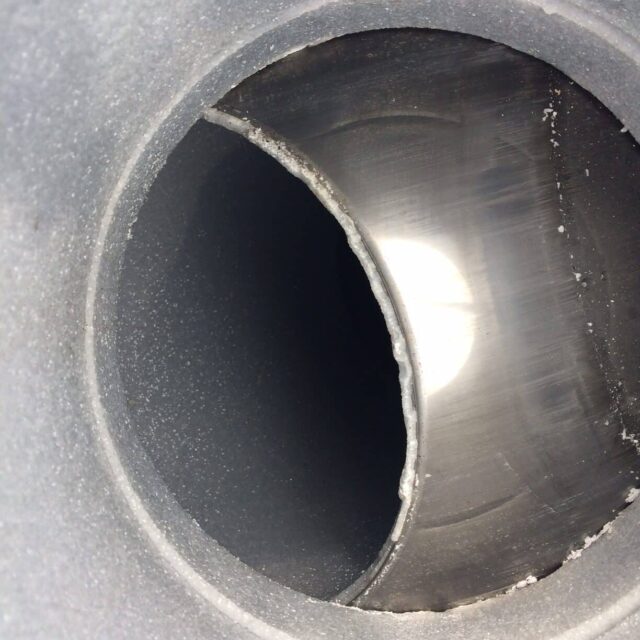
In CO₂ applications, metal-seated ball valves are a key solution for safe shut-off. Our gas-tight ball valves ensure high reliability and long service life through the metal-to-metal sealing between ball and seat ring. This design prevents CO₂ diffusion into sealing materials, shows no aging or volume change, and eliminates the risk of Anti Explosive Decompression, Explosive Decompression, and Rapid Gas Decompression (AED/ED/RGD).
Compared to gate valves, ball valves offer the advantage of reliable closing even in the presence of deposits inside the pipeline and require significantly less maintenance. Integrated metal-seated ball valves provide a higher level of safety, as they are less prone to blocking, subject to lower wear, and do not require grease filling that could contaminate downstream equipment.
Learn more about the advantages of ball valves:
Our ball valves and wellheads meet the relevant requirements for CCS and CCU applications, including DVGW C 491, PED/PED Directive, TA Luft, as well as testing in accordance with ISO 15848. Depending on customer requirements, we supply equipment in compliance with PED, AD 2000, or API 6A. Solutions in accordance with API 6D are also available.
Depending on the project, additional international requirements are taken into account, for example from ISO or NORSOK.
Or call us or send us an e-mail. We look forward to your inquiry. You can reach us by this phone number: +49 5085 9801 0.